
The Message of Nicholas Black Elk: 'All is Really One'
- CG Judd

- Aug 4, 2025
- 3 min read

Nicholas Black Elk (1863-1950) was a wise man who successfully lived in two worlds: the indigenous world with the Lakota, a Native American tribe which is one of the three main subgroups of the Sioux people of the Great Plains; and the Catholic world, having been baptized in 1904.
Black Elk was a Lakota medicine man and healer for his community. From the age of 9 he had many visions of meeting ancestors and holy figures. He saw what was possible if earth and humanity united.

He was a second cousin to Crazy Horse (1840-1890), who he considered the greatest chief of all. They both fought in the Battle of Little Bighorn and the Wounded Knee Massacre, along with Sitting Bull (1831-1890). All three were prominent figures of the Lakota people and their struggles against the American expansion.
The Lakota people had to defend their homelands against white settlers, miners, and the U.S. Army. The gold discovered in the sacred Black Hills of the Lakota, led to treaties being broken and increasing conflict with the white men. This led to many battles from 1866 through 1890.
In 1932 John G. Neihardt wrote Black Elk Speaks, about Nicholas Black Elk's extraordinary spiritual journey and the history of his people in the late 1800s. His talents as a medicine man spread throughout Lakota territory which encompassed parts of South Dakota, North Dakota, Montana, Wyoming, and Nebraska.
In 1904 Black Elk was called to the bedside of a dying boy. There he met a Jesuit priest.
Black Elk was there to perform traditional Lakota healing, while the priest was summoned to perform last rights. Black Elk was interested in knowing more about this priest including any positive aspects in the white man’s culture. He followed Father Joseph Lindbender back to Hole Rosary Mission.
Black Elk was deeply moved by the Catholic teachings, was baptized and took the name Nicholas in honor of Saint Nicholas the Wonderworker. He then married another Lakota woman who was also Catholic, and they had several children which they raised as Catholic. Black Elk also continued his healing work in the Lakota traditions.


He used his new medium to teach his message of love and compassion, respect and reverence, for all, including nature and its creatures. He taught to forgive even the people who have hurt you. He saw the divinity in all life.
Nicholas Black Elk’s teachings of forgiveness were especially profound for many people in the indigenous community because of what they had gone through. Nicholas Black Elk taught his people to forgive those who had hurt them, and to let go of hate.
Black Elk was also known for his wonderful sense of humor and the fact that he loved to make jokes even in his healing work. Nicholas Black Elk continued to heal people who were sick and in need of help. Nicholas Black Elk eventually passed away naturally of old age, but his teachings continue today. He is celebrated in the indigenous and Catholic worlds.
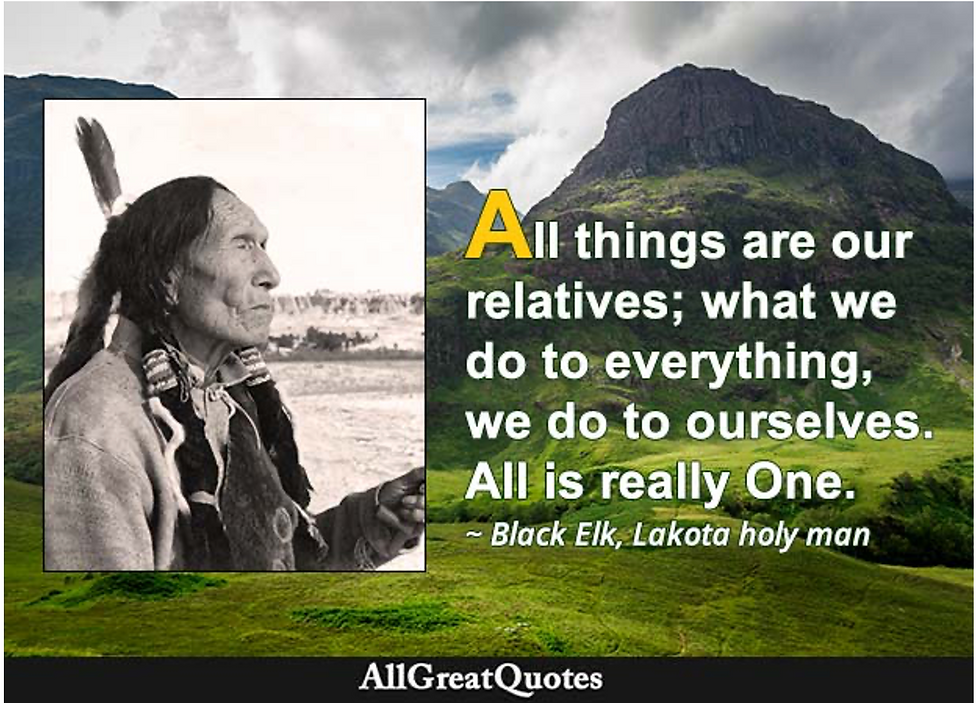
There has a been a call by his son and other members of the Catholic community to canonize him for his teaching the catholic faith to Native Americans. A petition with over 1,600 signatures was presented to Bishop Gruss by the Black Elk family. In my opinion Nicholas Black Elk should be canonized as this would be the historic first Native American man to be canonized as a saint. I think it would represent diversity in the Catholic family of Saints.
One of his most famous poems which I love is The Circle Poem.
I see that Black Elk’s teachings are coming into the awareness of more people. More people are discussing the benefit and wisdom of his message of unity and love. We need this now more than ever. To know we are all part of the one fabric, the one circle, the one family of life!


Comments